

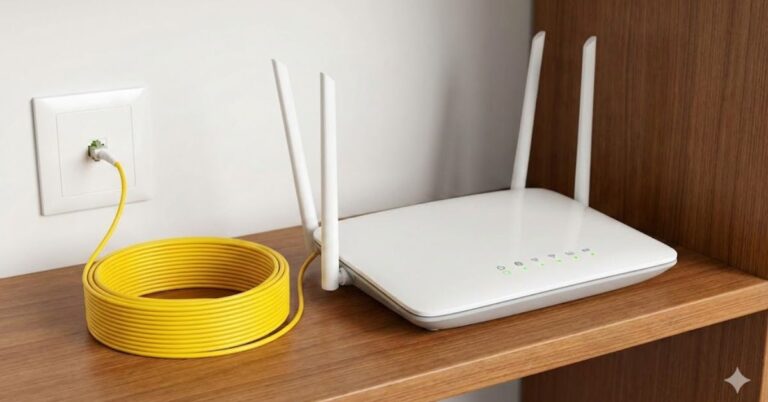
You just upgraded to fiber internet. You’re paying for 1 Gbps (or maybe even 2 or 5 Gbps), anticipating lightning-fast downloads and zero-lag gaming. But when you run a speed test on your phone, you’re only seeing 300 Mbps.
The problem isn’t your ISP; it’s likely your router.
Most standard routers especially the rental units provided by ISPs cannot handle the massive throughput of fiber optics. They lack the processing power and high-speed ports required to process gigabit speeds efficiently. Using an old router with fiber is like putting a go-kart engine inside a Ferrari; you have the potential for speed, but you can’t access it.
In this guide, we’ve analyzed and categorized the best routers for fiber internet in 2025 to help you stop the bottleneck and get the speeds you’re paying for.
Table of Contents
Quick Summary: Top Routers for Fiber at a Glance
If you want to skip the technical deep dive, here are our top recommendations based on performance, speed, and budget.
| Category | Product Model | WiFi Standard | Best For |
| Best Overall | ASUS RT-BE96U | WiFi 7 | Future-proofing, Multi-Gig plans (2Gbps+) |
| Best Value | TP-Link Archer BE3600 | WiFi 7 | Budget-conscious gigabit users |
| Best Gaming | ASUS ROG Rapture GT-AX11000 | WiFi 6 | Low latency, gamer-centric features |
| Best Mesh | TP-Link Deco BE63 | WiFi 7 | Large homes & dead zone elimination |
| Best Range | Netgear Nighthawk RS700S | WiFi 7 | Long-range coverage & max throughput |
Why Your Old Router Is “Choking” Your Fiber Connection?
Before we get to the reviews, it is critical to understand why specific hardware matters for fiber. Fiber internet differs from cable or DSL because it offers symmetrical speeds (upload speeds are as fast as download speeds) and incredibly low latency.
To handle this, your router needs three specific things:
- Multi-Gig WAN Ports: If you have a 2 Gbps plan but your router’s WAN port (the port connecting to the wall) is limited to 1 Gbps, your speed is instantly capped.
- High-Performance Processor: Routing gigabit traffic requires serious CPU power. Weak processors get overwhelmed, causing “bufferbloat” even on fast connections.
- WiFi 6E or WiFi 7: Older WiFi 5 (AC) standards physically cannot transmit gigabit speeds over the air in real-world scenarios. You need the 6GHz band found in WiFi 6E/7 to experience true fiber speeds wirelessly.
The Best Routers for Fiber Internet Reviewed:
1. ASUS RT-BE96U (Best Overall Premium Choice)
The Ultimate Powerhouse for Multi-Gig Fiber
If you have a fiber plan faster than 1 Gbps (like AT&T’s 2 Gig or Google Fiber’s 5 Gig), the ASUS RT-BE96U is arguably the best consumer router on the market. It utilizes the latest WiFi 7 standard, which introduces 320MHz channels effectively doubling the capacity for data transmission compared to WiFi 6.
- Why it’s great for fiber: It features dual 10G ports. You can plug your fiber ONT (Optical Network Terminal) into the 10G WAN port and still have a 10G LAN port left over for a high-speed switch or PC.
- Speed: Tri-band BE19000 (up to 19 Gbps total throughput).
- Pros: Future-proof WiFi 7, incredible range, subscription-free security (AiProtection).
- Cons: Expensive; large physical footprint.
2. TP-Link Archer BE3600 (Best Budget/Value)
Gigabit Performance for Under $150
You don’t need to spend $600 to get good fiber performance. The TP-Link Archer BE3600 is a rare find that offers WiFi 7 technology at an entry-level price point. While it lacks the raw horsepower of the ASUS above, it is perfect for the standard 1 Gbps fiber plan.
- Why it’s great for fiber: It includes one 2.5 Gbps WAN port. This ensures that if your fiber provider “over-provisions” your line (delivering 1.2 Gbps on a 1 Gbps plan), this router can actually accept that extra speed.
- Speed: BE3600 (3.6 Gbps total throughput).
- Pros: extremely affordable, supports EasyMesh, compact design.
- Cons: No 6GHz band (dual-band only), limited to 1 Gbps LAN ports for wired devices.
3. ASUS ROG Rapture GT-AX11000 Pro (Best for Gaming)
Zero-Lag Performance for Competitors
Fiber is the best connection for gaming due to low latency, and this router preserves that advantage. The ROG Rapture GT-AX11000 Pro is a “gamers-first” router designed to prioritize gaming packets above everything else on the network.
- Why it’s great for fiber: It uses a powerful quad-core processor dedicated to managing heavy traffic loads without hiccups. It also features “Triple-Level Game Acceleration” to route game traffic to the quickest server.
- Speed: WiFi 6 (AX11000).
- Pros: Dedicated 2.5G port, aggressive aesthetic, superb software for network management.
- Cons: “Gamer” design isn’t for everyone; WiFi 6 (not 6E/7).
4. TP-Link Deco BE63 (Best Mesh System)
Blanket Coverage for Large Homes
Fiber optics enter your home at a single point, which is often in a garage or corner room. If you have a large house, a single router won’t cut it. The Deco BE63 is a Mesh WiFi system that uses multiple units to create a seamless web of coverage.
- Why it’s great for fiber: Unlike older mesh systems that lose speed as you move away from the main unit, the BE63 uses WiFi 7 and wired backhaul options to maintain near-gigabit speeds in every room. It comes with four 2.5 Gbps ports per unit, which is unheard of at this price.
- Speed: BE10000.
- Pros: Incredible value for WiFi 7 mesh, excellent wired backhaul options, simple app setup.
- Cons: Advanced security features require a subscription.
5. Netgear Nighthawk RS700S (Best Range)
The Long-Range Beast
The RS700S is Netgear’s tower-style flagship. Its vertical antenna design is engineered specifically to push WiFi signals through walls and floors better than traditional flat routers.
- Why it’s great for fiber: It supports the 10 Gig fiber revolution with a 10 Gig internet port. It creates a massive coverage bubble, making it ideal for medium-to-large homes where you don’t want to deal with the complexity of a mesh system.
- Speed: WiFi 7 (BE19000).
- Pros: sleek aesthetic, 10 Gig WAN/LAN, massive throughput.
- Cons: Very expensive; Netgear charges extra for Armor security and parental controls.
How to Choose the Right Router? (Buying Guide)
When shopping for the best router for fiber internet, ignore the marketing fluff and look at these three specifications:
1. WAN Port Speed
Look at the port labeled “WAN” or “Internet.”
- For < 1 Gbps Plans: A standard Gigabit WAN port is fine.
- For > 1 Gbps Plans: You must have a 2.5G or 10G WAN port. If you plug a 2 Gbps fiber line into a 1 Gbps port, you are throwing away half your speed.
2. WiFi Standard
- WiFi 6 (802.11ax): The minimum standard you should accept today. Good for speeds up to 1 Gbps.
- WiFi 6E: Adds the 6GHz band. Essential if you live in a crowded apartment building to avoid interference.
- WiFi 7 (802.11be): The future. Required for multi-gig wireless speeds.
3. Processor (CPU)
Fiber allows you to download massive files in seconds. This requires the router to sort data packets incredibly fast. Look for Quad-Core processors (1.8 GHz or higher). Weak CPUs lead to high ping and jitter during gaming, even if your fiber line is perfect.
Setup Tip: Bridge Mode
Most fiber ISPs provide a gateway (a modem/router combo). If you buy a new router, do not just plug it into the ISP box, or you will create a “Double NAT” issue (which breaks gaming and VPNs).
The Fix:
- Log into your ISP-provided gateway.
- Enable “Bridge Mode” or “IP Passthrough.”
- This turns off the ISP router’s WiFi and routing functions, allowing your new high-performance router to handle everything.
Conclusion: Which One Should You Buy?
Don’t let mediocre hardware sabotage your premium internet connection.
- If you want the absolute best performance and have a budget for it, go with the [ASUS RT-BE96U](URL 1).
- If you want to save money but still get modern WiFi 7 speeds, the TP-Link Archer BE3600 is the smartest buy in 2025.
FAQ:
Do I need a modem with fiber internet?
Technically, no. Fiber uses an ONT (Optical Network Terminal), which converts light signals into digital signals. The ONT usually looks like a small box on your wall. You connect your router directly to the ONT via an Ethernet cable.
Can I use the router my ISP gave me?
You can, but we don’t recommend it for power users. ISP routers are often refurbished, have locked firmware, and lack the WiFi range to cover a whole home. They are designed for “good enough” connectivity, not maximum performance.
What is the difference between WiFi 6 and WiFi 7 for fiber?
WiFi 7 introduces MLO (Multi-Link Operation), which allows devices to connect to two bands (like 5GHz and 6GHz) simultaneously. For fiber users, this means if one band gets congested, your speed doesn’t drop because the data instantly shifts to the other band.
Will a better router improve my ping?
Yes, but only if your current router is the bottleneck. A high-end router with QoS (Quality of Service) can prioritize gaming traffic over Netflix streaming, ensuring your ping stays low even when someone else is downloading a 50GB file.
