

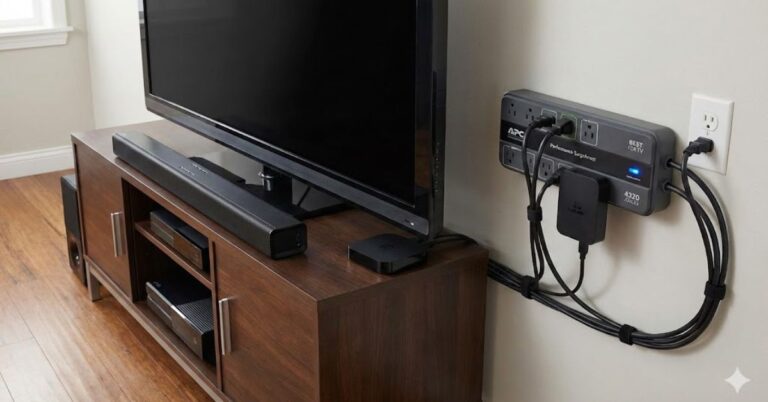
You have invested heavily in your 4K OLED TV and sound system, but plugging them into a cheap power strip puts it all at risk. A single power spike from a storm or grid fluctuation can ruin your setup instantly.
Finding the best surge protector for TV setups is the only insurance that prevents damage before it happens. Unlike standard strips, a true surge protector acts as a firewall, filtering dangerous voltage to keep your electronics safe. Here is how to choose the right protection for your home theater in 2025.
Table of Contents
Quick Comparison: Top 5 Surge Protectors
If you need immediate protection, here are the top-tested models that balance safety, performance, and value.
| Model | Best For | Joule Rating | Outlets | Warranty |
| Anker 341 USB Power Strip | Overall Best | 2,100 J | 12 + USB | $300k |
| Tripp Lite Isobar (6-Outlet) | Heavy Duty / Audio | 3,330 J | 6 | Lifetime |
| Austere VII Series | High-End OLEDs | 4,000 J | 6 or 8 | Lifetime |
| Belkin 12-Outlet Pivot-Plug | Budget / Gamers | 4,320 J | 12 | $300k |
| Sanus In-Wall Power Kit | Wall-Mounted TVs | N/A (Pass-through) | 2 | 5-Year |
What Makes a “Best” Surge Protector? (Buying Guide)
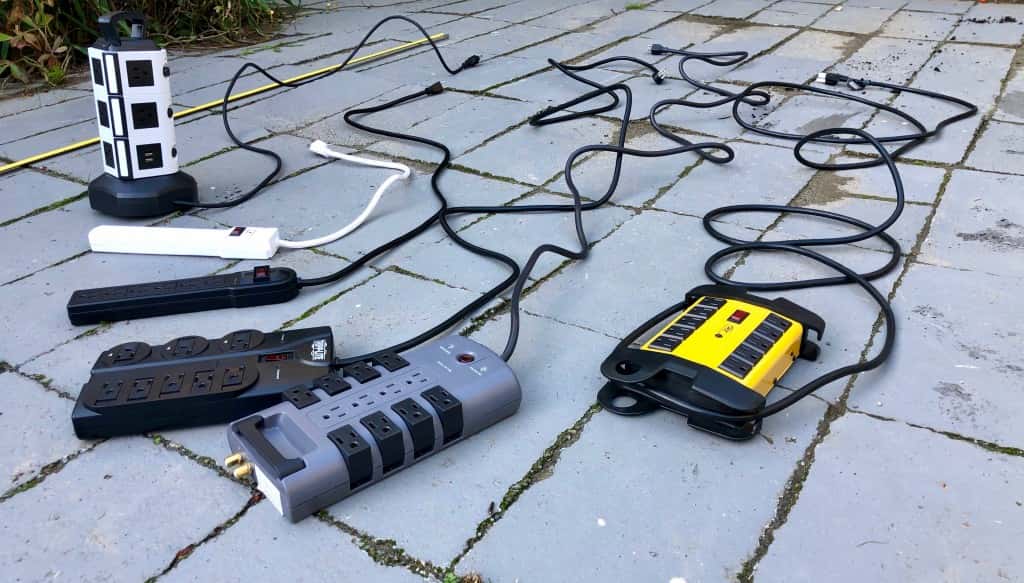
Before you buy, it is crucial to understand that not all “power strips” offer protection. To ensure you are actually safeguarding your TV, you need to look at three specific technical specifications.
1. Joule Rating (The Energy Absorber)
Think of Joules as a fuel tank. The Joule rating indicates how much energy the surge protector can absorb before it fails. Every time a small spike hits your home’s wiring, it “uses up” some of those Joules.
- Standard TV: 1,000 Joules minimum.
- 4K / OLED / Gaming Setup: We strongly recommend 2,000 to 3,000+ Joules. High-definition displays have sensitive microprocessors that are easily damaged by voltage irregularities.
2. Clamping Voltage (The Reaction Threshold)
This is the specific voltage level at which the surge protector “wakes up” and starts diverting excess energy away from your TV.
- The Rule: Lower is better.
- Look for a clamping voltage of 400V or lower (330V is the gold standard). If the clamping voltage is too high (e.g., 500V or more), your TV might suffer damage before the protector even activates.
3. Response Time
Surges travel instantly. You need a device that reacts in less than 1 nanosecond. Anything slower allows the initial spike to reach your TV’s power supply board, potentially causing HDMI port failure or a “dead set.”
4. EMI/RFI Noise Filtering
Did you know “dirty power” can degrade your picture? Electromagnetic Interference (EMI) and Radio Frequency Interference (RFI) can introduce static, audio hum, or visual artifacts. The best surge protector for TV configurations includes noise filtration (often -40dB or better), effectively acting as a power conditioner to ensure your audio and video signals remain pristine.
In-Depth Reviews: The Best Surge Protectors for 2025
1. Best Overall: Anker 341 (12-Outlet) USB Power Strip
For most living rooms, the Anker 341 is the perfect blend of utility and safety. Anker has dominated the charging market, and their surge protectors are equally reliable.
- Why It Wins: It features a smart 3-sided design, meaning bulky plugs won’t block neighboring outlets. With 2,100 Joules of protection, it is robust enough for a standard 4K TV and soundbar setup.
- Bonus: It includes two USB-A and one USB-C port, allowing you to power streaming sticks (like Fire TV or Roku) directly without needing an extra wall adapter.
- Verdict: The best balance of price and performance for 90% of users.
2. Best Heavy-Duty & Audiophile: Tripp Lite Isobar
If you live in an area with frequent lightning or unstable power grids, the Tripp Lite Isobar is legendary. It looks like a piece of industrial equipment because it is built like one.
- Why It Wins: It features an all-metal housing that won’t melt or burn in a catastrophic surge. More importantly, it uses isolated filter banks. This means the noise from a device plugged into Outlet 1 (like a mini-fridge or fan) won’t bleed over and cause interference in Outlet 2 (your amplifier).
- Verdict: The ultimate choice for audiophiles and those prioritizing function over form.
- [Insert Internal Link: URL 1 -> home theater installation services]
3. Best for High-End Design: Austere VII Series Power
When you have a slim, wall-mounted OLED that looks like art, you don’t want a clunky plastic brick on the floor. Austere makes surge protectors that are designed to be seen.
- Why It Wins: Beyond its brushed aluminum aesthetic, it boasts a massive 4,000 Joule rating. It uses “flameless MOV” technology, which adds a layer of safety against fire risks during massive surges.
- Verdict: Expensive, but worth it for luxury setups where aesthetics matter as much as performance.
4. Best Budget & Utility: Belkin 12-Outlet Pivot-Plug
If you have a gaming setup with an Xbox, PlayStation, Switch, and router, you know the pain of “wall wart” power bricks.
- Why It Wins: The outlets on the side of this strip pivot, allowing you to plug in large adapters without blocking other sockets. It offers a massive 4,320 Joule rating—one of the highest on our list—making it an incredible value.
- Verdict: The problem-solver for gamers with too many devices.
5. Best for Wall Mounting: Sanus In-Wall Power Kit
Hanging a TV? Dangling cords are a dealbreaker.
- Why It Wins: This device installs inside the wall, creating a recessed outlet behind your TV so it can sit flush.
- Important Note: This is typically a “pass-through” device. You must plug the bottom input into a surge protector on the floor to ensure the TV is actually protected.
- Verdict: Essential for the “floating TV” look.
Why a Power Strip Is Not Enough?
A common misconception is that any strip of outlets offers protection. This is false. A standard power strip is merely an extension cord. If 10,000 volts come through the line, a power strip will pass all 10,000 volts into your TV.
A surge protector uses a component called a Metal Oxide Varistor (MOV). The MOV acts like a pressure valve. Under normal conditions, it does nothing. But when voltage spikes, the MOV diverts the excess energy to the grounding wire.
Warning: MOVs are “sacrificial.” Over time, they wear out. If you have been using the same surge protector since 2015, its protection capability is likely gone, even if the outlets still work.
Step-by-Step: How to Install for Maximum Safety
- Inspect Your Outlets: Ensure your wall outlet is properly grounded. Surge protectors cannot function without a ground wire (the third prong).
- Check the “Protected” Light: When you plug it in, look for a green LED labeled “Protected.” If this light ever goes out, the unit has sacrificed itself to save your gear and needs to be replaced immediately.
- Cable Management: Separate your power cables from your HDMI and audio cables. Running them parallel can induce noise. Cross them at 90-degree angles if they must touch.
- [Insert Internal Link: URL 2 -> cable management tips]
- Avoid Daisy Chaining: Never plug a surge protector into another surge protector or extension cord. This is a fire hazard and violates electrical codes.
Conclusion:
Your television is likely the centerpiece of your living room, and leaving it unprotected is a gamble you don’t need to take. For most homes, the Anker 341 offers the perfect mix of modern features and reliable safety. For those with high-end audio needs, the Tripp Lite Isobar remains the gold standard.
Remember, the best surge protector for TV setups is one that is fresh. If you are still using an old, yellowing strip from the garage, replace it today. It is a small price to pay to ensure your next movie night isn’t interrupted by a blackout.
Frequently Asked Questions:
How many joules do I need for a 4K TV?
For a 4K or OLED TV, you should aim for a surge protector with at least 2,000 Joules. This ensures the device can absorb significant energy spikes without failing, keeping your sensitive display safe.
Does a surge protector affect picture quality?
Yes, it can improve it. High-quality surge protectors with EMI/RFI filtration remove electrical “noise” from the power line. While modern digital signals are resilient, removing this noise can prevent subtle audio hums or video artifacts, resulting in a cleaner performance.
What is the difference between a surge protector and a UPS?
A surge protector diverts excess voltage to prevent damage. A UPS (Uninterruptible Power Supply) does that plus provides battery backup. A UPS will keep your TV running for a few minutes during a power outage, allowing you to shut it down properly, which can save projector bulbs and prevent hard drive corruption in gaming consoles.
Can I plug a surge protector into an extension cord?
No. You should never “daisy chain” surge protectors or plug them into extension cords. They must be plugged directly into a wall outlet to function safely and effectively. Doing otherwise can overheat the wires and void your warranty.
How often should I replace my surge protector?
You should replace your surge protector every 3 to 5 years, or immediately if the “Protected” indicator light turns off. The internal components degrade with every small surge they absorb, so they do not last forever.
