

If you are planning a kitchen renovation or simply replacing an old stove, you have likely stared at the smooth, black glass surfaces of modern cooktops and wondered: What is actually the difference?
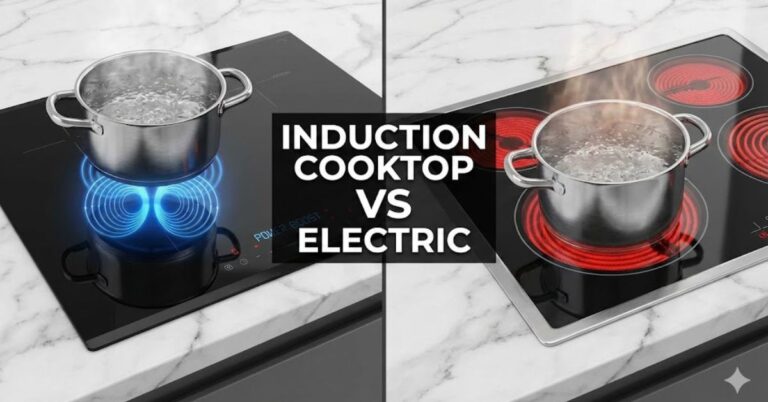
At a glance, an induction cooktop vs electric radiant model looks almost identical. They both offer that sleek, modern aesthetic that homeowners love. However, beneath that glass surface, they are completely different beasts. One relies on traditional thermal heating, while the other uses advanced magnetic technology to cook your food faster and safer.
In this guide, we will cut through the technical jargon and compare these two popular options head-to-head. We’ll cover heating speed, energy efficiency, safety, and cost so you can decide which one deserves a spot on your countertop.
Table of Contents
The Core Difference: How They Work
Before we dive into the pros and cons, it is vital to understand the technology. This is the main factor that influences performance and price.
What is a Radiant Electric Cooktop?
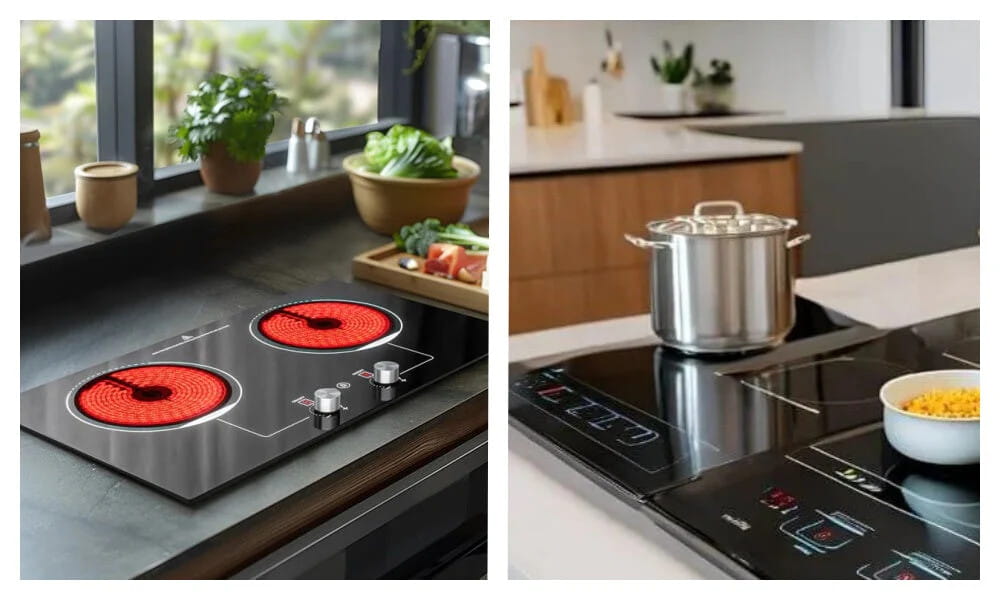
Standard electric cooktops (often called radiant cooktops) use metal coils beneath the glass surface. When you turn the dial, electricity flows through these coils, causing them to glow red hot. This heat transfers to the glass ceramic surface, which then transfers to your pot or pan. It is a chain reaction: Coil → Glass → Pan → Food.
What is an Induction Cooktop?
Induction is a game-changer. Instead of heating a coil, it uses copper coils to create a magnetic current. This current bypasses the glass surface entirely and excites the molecules inside your cookware. Essentially, the pan itself becomes the heat source. The chain reaction is shorter: Magnetic Field → Pan → Food.
1. Heating Speed and Efficiency
Winner: Induction
When comparing induction cooktop vs electric regarding speed, there is no contest. Induction is significantly faster.
Because induction turns your cookware into the heat source, there is almost zero energy loss. You can bring a large pot of water to a boil in roughly half the time it takes on a standard electric burner.
- Induction efficiency: ~90% of energy goes into the food.
- Electric efficiency: ~65-70% of energy is used; the rest is lost as ambient heat.
If you are a busy parent who needs to get pasta on the table in 15 minutes, induction is the clear hero here.
2. Temperature Control and Precision
Winner: Induction
Have you ever turned down a boiling pot on an electric stove, only to watch it boil over anyway because the coils were still hot? That is “thermal lag.”
- Electric: The coils take time to heat up and time to cool down. It is a slow response.
- Induction: The response is instantaneous. When you lower the temperature, the magnetic field changes immediately. It gives you gas-like control without the open flame, making it perfect for delicate tasks like melting chocolate or simmering sauces.
3. Safety Features
Winner: Induction
Safety is a massive factor, especially for families with young children or aging adults.
- No Open Heat: Since induction only heats the cookware, the unused glass surface remains relatively cool. You are much less likely to burn yourself if you accidentally touch the stove next to the cooking zone.
- Auto Shut-Off: Most induction cooktops have sensors. If you remove the pan, the heating stops immediately. If you forget to turn an electric burner off, it stays hot until you physically switch it off.
- Residual Heat: While the glass under the pot will get warm (because the hot pan sits on it), it cools down much faster than the searing hot surface of a radiant electric stove.
4. Cookware Compatibility
Winner: Electric
This is the biggest hurdle for new induction owners. Because induction relies on magnetism, your pots and pans must be magnetic.
For induction, you need:
- Cast iron
- Enameled cast iron (like Le Creuset)
- Most stainless steel (check the bottom)
For electric, you can use:
- Everything above
- Copper
- Aluminum
- Glass
- Ceramics
The Magnet Test: Not sure if your current set works? Take a fridge magnet and stick it to the bottom of your pot. If it sticks firmly, it is induction-ready. If it falls off, you will need new cookware.
5. Cleaning and Maintenance
Winner: Induction
Both cooktops feature smooth glass-ceramic surfaces that are easier to wipe down than old gas grates. However, induction has a secret advantage.
Because the surface of an electric cooktop gets scorching hot, spills and splatters bake onto the glass instantly. You often have to scrub hard with specialized cleaners and razor scrapers to remove burnt-on food.
With induction, the surface around the pan doesn’t get hot enough to burn food. Spilled sauce usually wipes right off with a damp cloth, even while you are cooking.
6. Cost Comparison: Upfront vs Long-Term
Winner: Electric (Upfront) / Induction (Long-Term)
- Upfront Cost: A standard electric cooktop is generally cheaper to buy and install. If you are renovating on a tight budget, electric is the wallet-friendly choice.
- Running Cost: Because induction is faster and more energy-efficient, it costs less to operate over time. You use less electricity to cook the same meal.
However, do not forget the “hidden” cost of induction: you might need to replace your non-magnetic cookware, which can add hundreds of dollars to the initial price tag.
Comparison at a Glance:
To summarize the induction cooktop vs electric debate, here is a quick breakdown:
| Feature | Induction Cooktop | Electric (Radiant) Cooktop |
| Heating Speed | Extremely Fast | Moderate |
| Energy Efficiency | High (~90%) | Medium (~70%) |
| Safety | Surface stays cooler; auto-shutoff | Surface gets very hot; retains heat longer |
| Cookware | Must be magnetic (Cast iron, Steel) | Any flat-bottom cookware |
| Cleaning | Easy (food doesn’t burn on) | Harder (spills bake on) |
| Price | Higher upfront | More affordable |
Which One Should You Buy?
Choose an Induction Cooktop if:
- You want the fastest boiling times and precise temperature control.
- Safety is a priority (cool-to-the-touch surface).
- You want the easiest cleanup possible.
- You are willing to invest more upfront for better performance.
Choose an Electric Cooktop if:
- You are on a stricter budget for the appliance purchase.
- You have a large collection of copper, aluminum, or glass cookware you don’t want to replace.
- You cook infrequently and don’t need professional-level speed.
Conclusion:
The battle of induction cooktop vs electric ultimately comes down to your budget and your cooking style. While electric cooktops are reliable and accessible, induction offers a superior cooking experience that is faster, safer, and cleaner. It is rapidly becoming the standard for modern kitchens.
If your budget allows and your pots are magnetic making the switch to induction is an upgrade you won’t regret.
Frequently Asked Questions:
Is induction better than electric?
For performance, yes. Induction heats faster, wastes less energy, and offers more precise temperature control than traditional electric cooktops. However, electric is often better for those on a budget or those with non-magnetic cookware.
Do induction cooktops use more electricity?
No, they actually use less. Because induction is 85-90% efficient at transferring heat directly to the food, you run the appliance for less time compared to an electric stove, saving energy on your utility bill.
Can I use cast iron on an induction cooktop?
Yes! Cast iron is perfect for induction cooking because it is highly magnetic. Just be careful when placing heavy cast iron pans on the glass surface to avoid scratches.
Do induction cooktops scratch easily?
Both induction and electric cooktops use similar glass-ceramic surfaces. They can scratch if you drag rough pans across them (like cast iron). However, since induction doesn’t bake food onto the surface, you are less likely to scratch it while scrubbing off burnt messes.
