

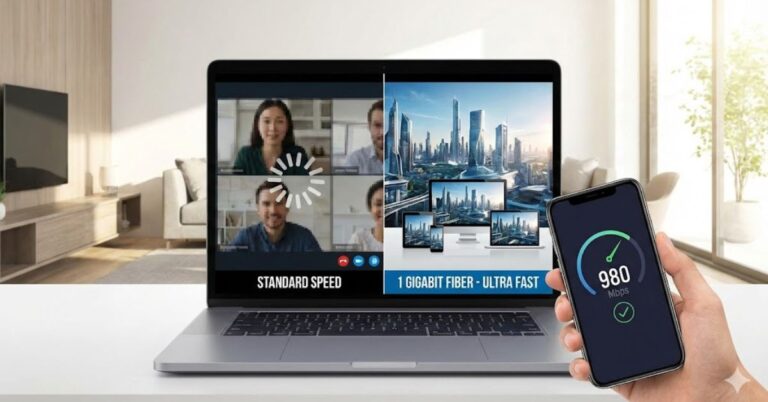
We have all been there. You are in the middle of a high-stakes ranked match, or perhaps you are about to present a crucial slide during a remote board meeting, and suddenly the screen freezes. The spinning wheel of death appears.
In our hyper-connected world, slow internet isn’t just an annoyance; it’s a productivity killer. As Internet Service Providers (ISPs) race to offer faster connections, you have likely seen advertisements for “Gigabit Internet.” But beyond the flashy marketing, is 1 gig internet good for the average user, or is it overkill?
The short answer is: Yes, it is exceptional. But whether you strictly need it depends on your household’s digital habits. In this guide, we will cut through the technical jargon to help you decide if upgrading to 1000 Mbps is the right move for you.
Table of Contents
Understanding the Basics: What is 1 Gig Internet?
To understand the value, you have to understand the math. Internet speed is measured in Megabits per second (Mbps).
- Standard High-Speed Internet: Usually ranges from 100 Mbps to 300 Mbps.
- Gigabit Internet: Offers speeds of 1,000 Mbps (1 Gigabit per second).
That means 1 Gig internet is roughly 10 times faster than the average “fast” connection many households currently use. This massive bandwidth pipeline allows vast amounts of data to travel to your home simultaneously without clogging the network.
Who Actually Needs Gigabit Internet?
While having the fastest speeds available sounds great, it usually comes with a higher price tag. So, who benefits the most from this tier of service?
1. The Hardcore Gamer
If you game competitively, you know that every millisecond counts. While raw speed doesn’t always equal lower latency (ping), a Gigabit connection ensures that no one else in the house streaming Netflix will cause your game to lag.
- Benefit: Download massive game files (often 100GB+) in minutes rather than hours.
2. The Content Creator & Streamer
For YouTubers, Twitch streamers, and video editors, upload speed is just as important as download speed.
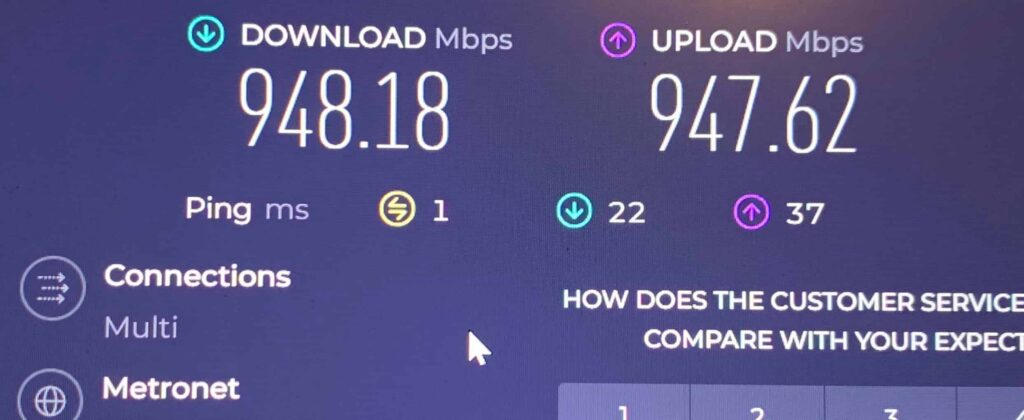
- Benefit: If you are on a Fiber Gigabit plan, you often get “symmetrical speeds” (1000 Mbps download and 1000 Mbps upload), making 4K live streaming buttery smooth.
3. The “Smart” Household
Does your home feel like a tech store? If you have smart fridges, 4K TVs in every room, security cameras, tablets, and smartphones all connected at once, bandwidth runs out fast.
- Benefit: 1 Gig internet eliminates bandwidth congestion. You can have 10+ devices running data-heavy tasks simultaneously without a hitch.
4. Remote Workers and Large Families
If you have two parents on video calls and three kids in virtual classrooms or streaming Disney+, a standard connection will struggle.
- Benefit: Crystal clear video conferencing regardless of what the rest of the family is downloading.
Pro Tip: If you are setting up a home office, ensure you have the right equipment. You might want to check our guide on to optimize your setup for maximum efficiency.
Real-World Speed Test: How Fast is It?
Numbers on a page are one thing, but time saved is the real metric. Here is a breakdown of how long it takes to download different types of media on a standard connection versus Gigabit internet.
| Media Type | File Size | 100 Mbps Connection | 1 Gig (1000 Mbps) Connection |
| HD Movie | 4 GB | ~5.5 minutes | ~32 seconds |
| 4K Movie | 20 GB | ~28 minutes | ~2.5 minutes |
| Modern Console Game | 100 GB | ~2.5 hours | ~14 minutes |
| Spotify Song | 5 MB | ~0.5 seconds | Instant |
As you can see, for large files, the difference is night and day. If you frequently download large assets, the time you save in a single month could justify the cost.
The “Fine Print”: Factors That Affect Your Speed
Asking “is 1 gig internet good” also requires asking if your hardware can handle it. You cannot put a Ferrari engine in a go-kart and expect it to perform.
Router and Modem Limitations
If you subscribe to a Gigabit plan but use a router from 2015, you will never see those top speeds.
- Wi-Fi 5 vs. Wi-Fi 6: To get close to Gigabit speeds over wireless, you generally need a Wi-Fi 6 router.
- Ethernet Cables: You must use Cat5e or Cat6 Ethernet cables. Older Cat5 cables are capped at 100 Mbps.
Wi-Fi vs. Wired Connections
It is important to manage expectations. You will rarely see a full 1000 Mbps speed test on a phone connected via Wi-Fi. Wireless signals degrade through walls and over distance. To get the full potential of Gigabit internet, a wired Ethernet connection to your PC or console is always best.
If you are unsure about which hardware works best with high-speed plans, looking into can help clarify which devices are compatible with your ISP.
Is 1 Gig Internet Worth the Cost?
For most users, the answer is a nuanced “maybe.”
It IS worth it if:
- You live in a household with 4+ heavy internet users.
- You regularly download large files (50GB+).
- You rely on cloud storage for work (uploading video projects).
- You want to future-proof your home network.
It might NOT be worth it if:
- You live alone or with one other person.
- You mostly browse the web, use social media, and stream in 1080p.
- You are on a tight budget (Gigabit plans are premium).
Common Myths About Gigabit Internet
Myth 1: “It will make my web browsing faster.”
Not really. Loading a standard webpage takes very little data. Whether you have 100 Mbps or 1000 Mbps, Google will load instantly. The difference is only noticeable during heavy data loads.
Myth 2: “I need 1 Gig for 4K Netflix.”
Netflix recommends 15-25 Mbps for a 4K stream. Technically, a 100 Mbps connection can handle three or four 4K streams at once. You buy 1 Gig for the headroom, not the bare minimum.
Conclusion:
So, is 1 gig internet good? Absolutely. It is currently the gold standard for residential internet connections. It offers unparalleled freedom from buffering, incredible download speeds, and the ability to support a house full of smart devices.
However, it is not a magic wand. It requires capable hardware (routers and cables) to work effectively. If you are a heavy user, a gamer, or part of a large digital family, the upgrade will likely improve your quality of life significantly. If you are a casual browser, you might save money by sticking to a 300 Mbps or 500 Mbps plan.
Ready to upgrade your home network? Before you call your ISP, assess your current usage and hardware to ensure you get the speed you pay for.
Frequently Asked Questions:
Is 1 gig internet overkill for a single person?
For a single person who simply streams movies and browses the web, yes, 1 gig is likely overkill. However, if that single person is a professional video editor or a competitive gamer downloading new titles daily, it is a valuable tool.
Is 1000 Mbps good for gaming?
Yes, 1000 Mbps is excellent for gaming. While speed doesn’t directly lower ping (latency), the massive bandwidth ensures that if your phone updates an app or someone else starts a movie, your gaming session won’t lag.
Do I actually get 1000 Mbps on Wi-Fi?
Rarely. Under perfect conditions with a Wi-Fi 6 router and a modern device right next to the antenna, you might see speeds of 600–900 Mbps. Real-world Wi-Fi speeds are usually lower due to interference and distance, usually hovering between 300–600 Mbps on a Gigabit plan.
What is the difference between Fiber and Cable Gigabit internet?
Both offer fast download speeds. However, Fiber internet usually offers “symmetrical” speeds (1000 Mbps download / 1000 Mbps upload), whereas Cable internet often has fast downloads but much slower uploads (e.g., 1000 Mbps download / 35 Mbps upload).
