

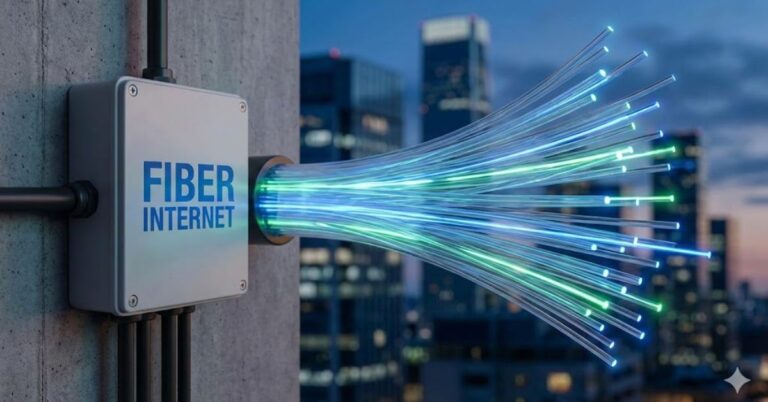
If you’ve ever lost a connection during a crucial Zoom call or watched a 4K movie buffer into a pixelated mess, you’ve likely asked yourself: is fiber internet better than cable?
For years, cable internet was the gold standard for high-speed connectivity. It replaced dial-up and DSL, offering speeds that seemed limitless at the time. But the landscape has shifted. Fiber optic internet has emerged as the superior technology for heavy internet users, gamers, and work-from-home professionals, largely due to one game-changing factor: symmetrical speeds.
While cable internet relies on copper wiring originally designed for television, fiber optics use light signals transmitted through glass strands. This fundamental difference affects everything from your ping in video games to how fast you can back up your iPhone.
In this guide, we’ll break down the technical and practical differences between fiber and cable to help you decide if making the switch is worth it.
Table of Contents
The Core Difference: How They Work
To understand the performance gap, you have to look at the infrastructure buried underground.
Cable Internet (HFC)
Cable internet typically uses a Hybrid Fiber-Coaxial (HFC) network. The data travels via fiber lines to a node in your neighborhood, but the “last mile” the physical line connecting that node to your house is a copper coaxial cable (the same thick black wire that plugs into your TV box).
- The Bottleneck: Copper wires transmit data via electricity. They are susceptible to electromagnetic interference and signal loss over distance.
Fiber Internet (FTTH)
Fiber-to-the-Home (FTTH) eliminates the copper entirely. It uses flexible glass strands to transmit data as pulses of light.
- The Advantage: Light moves faster than electricity without generating heat or interference. This allows for massive bandwidth capacity that copper simply cannot physically match.
Speed Showdown: Is Fiber Internet Faster?
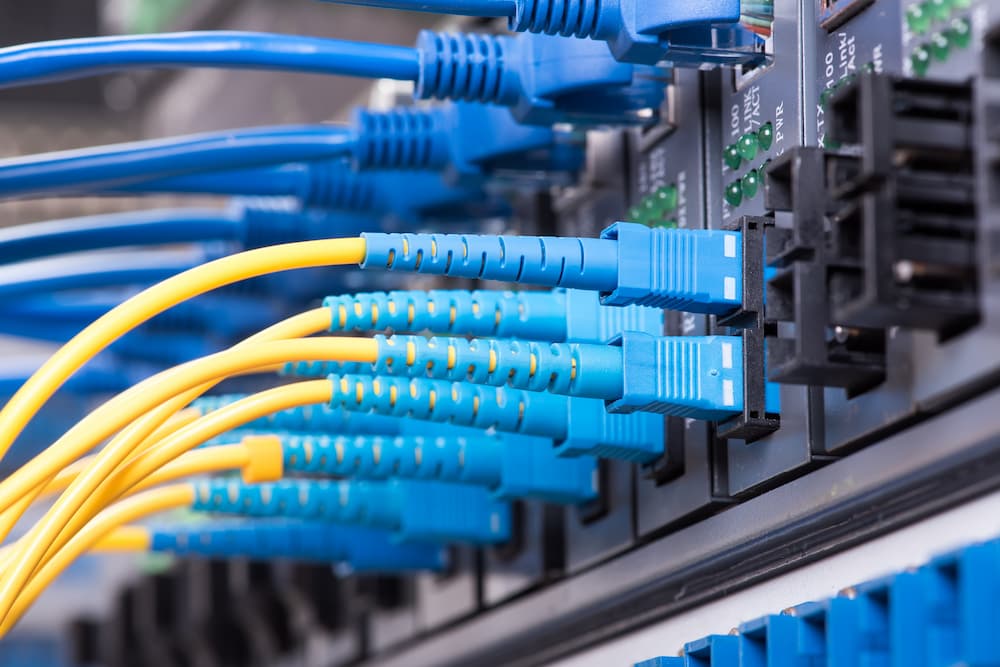
When you look at marketing flyers, you might see both cable and fiber providers advertising “1 Gig” (1,000 Mbps) speeds. If the numbers are the same, is fiber actually faster?
Yes, and here is why.
1. Symmetrical vs Asymmetrical Speeds
This is the single biggest differentiator.
- Cable is Asymmetrical: You might get 1,000 Mbps download speed, but your upload speed is likely capped at 35 to 50 Mbps. Cable networks were built for consumption (watching TV), not creation (uploading files).
- Fiber is Symmetrical: If you pay for a 1 Gig plan, you get 1,000 Mbps download AND 1,000 Mbps upload.
Why this matters: If you work from home, upload speed is what powers your video calls, sends large PDF files, and backs up your hard drive to the cloud.
2. Bandwidth Throttling and Sharing
Cable internet operates on a shared network loop. If your neighbors are all streaming 4K Netflix at 7:00 PM on a Friday, your speeds may dip because you are all fighting for the same local bandwidth capacity.
Fiber, specifically dedicated fiber lines, provides a direct pipeline to your home. While the backend network is still shared at the ISP level, the capacity of fiber is so high (often 10x that of cable) that “peak hour” slowdowns are virtually non-existent.
Expert Insight: If you frequently see “Network Unstable” warnings on Zoom despite having a “fast” cable plan, your low upload speed is likely the culprit not your download speed.
[Internal Link: Check out our High-Speed Internet Plans]
Reliability and Latency: The Gamer’s Choice
Speed is how much data you can move; latency (or ping) is how fast that data travels.
For gamers and day traders, latency is king.
- Fiber Latency: Typically 5–10 milliseconds.
- Cable Latency: Typically 20–50 milliseconds.
Because fiber uses light, the signal travels physically faster and cleaner. Cable networks suffer from higher “jitter” (fluctuations in ping) because the electrical signal faces resistance in the copper wire and must pass through multiple amplifiers.
Real-world impact: In a fast-paced game like Call of Duty or Valorant, a fiber player will see the enemy a fraction of a second before a cable player does. That fraction is the difference between winning and losing.
Comparison Table: Fiber vs Cable at a Glance
| Feature | Fiber Internet | Cable Internet | Winner |
| Download Speed | Up to 10 Gbps | Up to 1-2 Gbps | Fiber |
| Upload Speed | Symmetrical (matches download) | Asymmetrical (much slower) | Fiber |
| Reliability | 99.9% (Passive optics) | Susceptible to interference | Fiber |
| Latency (Ping) | 5-10ms (Low) | 20-50ms (Moderate) | Fiber |
| Availability | ~40-50% of households | ~90% of households | Cable |
| Cost | Competitive ($50-$90/mo) | Competitive ($50-$100/mo) | Tie |
Is Fiber More Expensive?
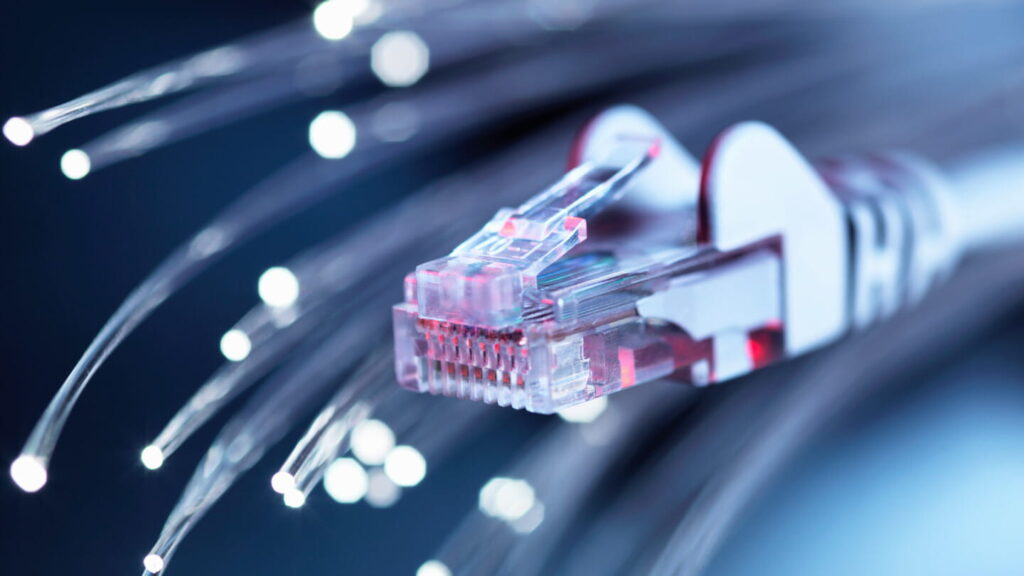
Historically, fiber was a premium product. Today, the pricing dynamic has flipped.
Because fiber networks are newer and require less maintenance (glass doesn’t corrode like copper), many fiber providers offer flat-rate pricing.
- Fiber Pricing: Often includes the modem/router and has no data caps.
- Cable Pricing: Often starts with a low “promo rate” that hikes up after 12 months. Cable plans frequently have hidden costs like equipment rental fees ($15/mo) and data caps (charging you extra if you exceed 1.2 TB of data).
When you calculate the “total cost of ownership” over two years, fiber is often cheaper than cable for the performance you get.
[Internal Link: View Our Installation Services]
Who Should Stick with Cable?
Despite fiber’s dominance, cable isn’t obsolete. It is the backbone of internet connectivity for the vast majority of the country.
You should choose cable if:
- Fiber isn’t available: This is the most common reason. Digging new fiber trenches is expensive, and many rural or older suburban areas only have access to coaxial networks.
- You bundle TV: Cable providers often offer deep discounts if you still subscribe to traditional cable TV packages.
- You are a light user: If you live alone and only browse the web and stream HD video, the difference between fiber and cable may be imperceptible to you.
Conclusion:
So, is fiber internet better than cable?
From a technical standpoint, the answer is an absolute yes. Fiber offers symmetrical speeds, lower latency, higher security, and better weather resistance. It is “future-proof” technology that can handle the bandwidth demands of the next decade.
However, the best internet is the one that connects you reliably. If you have access to fiber, you should almost certainly make the switch. If you don’t, modern cable internet (DOCSIS 3.1) is still a powerful contender capable of supporting most households.
Ready to upgrade your home network?
Frequently Asked Questions:
Is fiber internet good for gaming?
Yes, fiber is the best connection type for gaming. It offers the lowest latency (ping) and jitter, which prevents lag spikes. The symmetrical upload speeds are also crucial for gamers who stream their gameplay to Twitch or YouTube.
Why is my cable internet slow at night?
Cable internet uses a shared neighborhood loop. When everyone comes home from work and starts streaming video at the same time (peak hours), the total available bandwidth is split among more users, causing slowdowns. Dedicated fiber lines avoid this congestion.
Do I need a special modem for fiber internet?
Yes. Fiber internet requires an ONT (Optical Network Terminal), which translates light signals into digital signals. Most fiber ISPs install this box on your wall for free or a small fee, and you connect your router to it via Ethernet. You cannot use a standard cable modem (DOCSIS) for fiber service.
Is 5G home internet better than fiber?
No. 5G home internet is a wireless cellular connection. While it is easier to set up (no wires), it is generally slower, has higher latency, and is less stable than a hardwired fiber optic connection. Fiber is superior for performance; 5G is superior for flexibility.
