

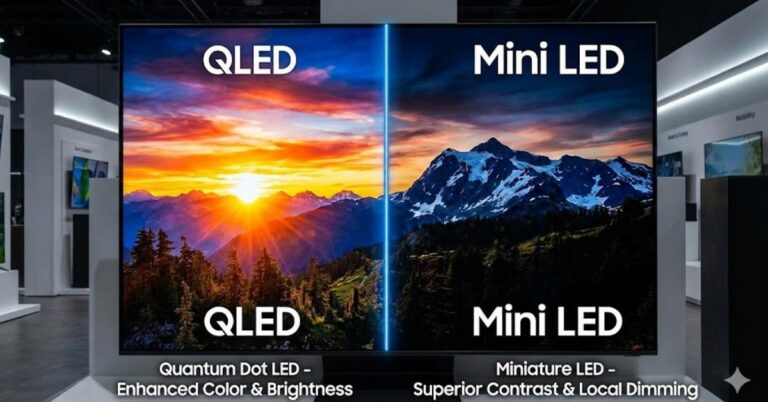
Buying a new TV in 2026 feels less like shopping and more like taking a physics exam. You’re bombarded with acronyms like OLED, QLED, Mini LED, Neo QLED, and QNED until your head spins.
If you’ve narrowed your search down to QLED vs Mini LED, you are on the right track. These are two of the most popular technologies on the market, offering incredible brightness and vibrant colors without the burn-in risk associated with OLED panels.
But here is the twist that most guides bury: These two technologies aren’t actually enemies. In fact, they often work together.
In this guide, we will cut through the marketing fluff to explain exactly how they differ, which one offers the best picture quality, and ultimately, which one is worth your money.
Table of Contents
The Short Answer: What is the Main Difference?
If you are in a rush, here is the “too long; didn’t read” breakdown:
- QLED (Standard) refers to a TV that uses Quantum Dots to produce rich, vibrant colors. However, standard QLED TVs usually rely on older, larger LED backlights. This makes them affordable but less precise at handling dark scenes.
- Mini LED refers to the backlight technology specifically. It uses thousands of tiny LEDs (instead of hundreds of big ones) to light up the screen. This results in far better contrast, deeper blacks, and less “blooming” (light leaking into dark areas).
The Verdict: Mini LED is the premium evolution of QLED. If you want the best performance for movies and gaming, Mini LED wins. If you are on a strict budget, Standard QLED is still a fantastic choice.
1. How the Technology Works (Simplified)
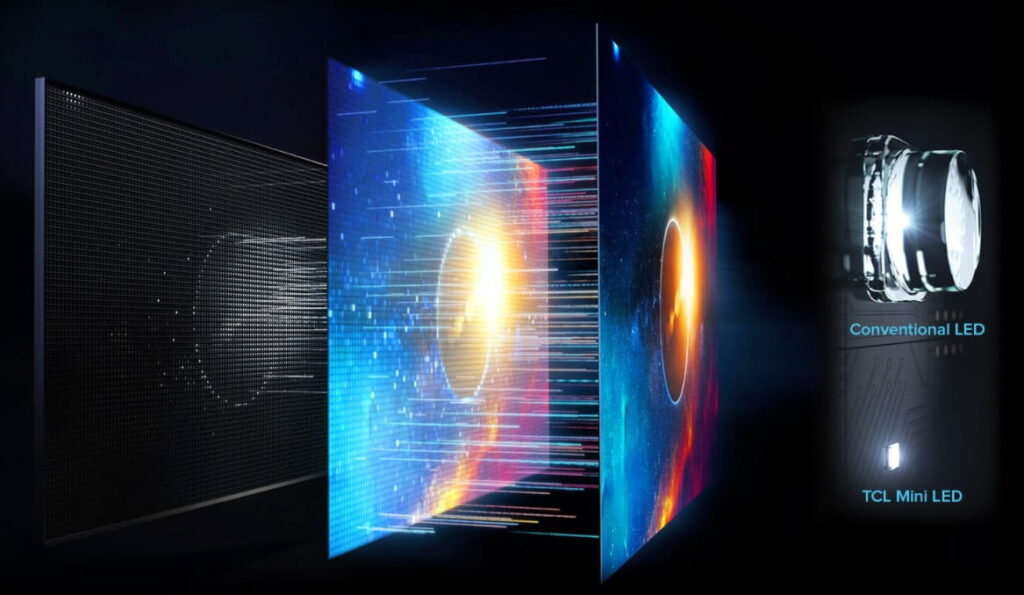
To understand the battle of QLED vs Mini LED, you have to understand how modern TVs create an image.
What is QLED?
QLED stands for Quantum Dot LED. The “magic” here is a layer of microscopic particles called quantum dots placed over the backlight. When light hits these dots, they emit incredibly pure, bright colors.
Think of QLED as a turbocharger for color. It makes reds redder and greens greener.
What is Mini LED?
Mini LED is exactly what it sounds like: Miniature LEDs.
Old-school LED TVs use large light bulbs behind the screen to create brightness. Because these bulbs are big, they can’t turn off precisely. If you have a bright moon on a black sky, the big bulb lights up the moon and the sky around it, turning the black sky gray.
Mini LED shrinks those bulbs to roughly 1/40th the size of standard LEDs. Because they are so small, manufacturers can pack thousands of them behind the screen. This allows the TV to light up the bright moon without washing out the dark sky next to it.
Note: Most high-end Mini LED TVs (like Samsung’s Neo QLED or TCL’s QM8) also use Quantum Dots. So, you are essentially getting “Mini LED QLED.”
2. Brightness and Blooming
This is where the biggest real-world difference lies.
The “Halo Effect” (Blooming)
Have you ever watched a movie with subtitles and noticed a ghostly gray cloud glowing around the white text? That is called blooming.
- Standard QLED: Because standard QLEDs have fewer “dimming zones” (areas of the screen that can brighten or dim independently), they struggle to keep black bars black. You will often see significant blooming around bright objects.
- Mini LED: With thousands of dimming zones, Mini LED TVs are surgical. They can light up a tiny star in a space movie while keeping the space around it pitch black. The blooming is virtually gone on top-tier models.
Peak Brightness
Both technologies are brighter than OLED. However, Mini LED takes the crown here. By packing in more LEDs, these TVs can hit staggering brightness levels (measured in nits).
If you watch TV in a living room with big windows and lots of sunlight, Mini LED is the undisputed king. It has the horsepower to cut through glare that would wash out other screens.
3. Contrast and Black Levels
Contrast is the difference between the brightest white and the darkest black on your screen. It is arguably the most important factor for picture quality.
- Standard QLED: Uses a backlight that is often “Always On” or has limited control. Blacks often look like dark gray, especially when watching in a dark room.
- Mini LED: Approaches the quality of OLED. Because the Mini LEDs can turn off in very specific clusters, the blacks are inky and deep.
Winner: Mini LED. It creates a “pop” and depth to the image that standard QLED simply cannot match.
4. Gaming Performance: 120Hz, VRR, and HDR
Gamers are one of the biggest audiences for these TVs. If you own a PS5, Xbox Series X, or a high-end PC, you care about refresh rates and input lag.
Why Mini LED is Better for Gamers
While you can find gaming features on standard QLEDs, Mini LED panels are usually reserved for the manufacturer’s “Premium” lineup. This means they almost always come with better gaming specs out of the box:
- 120Hz or 144Hz Refresh Rates: Smoother motion for shooters and racing games.
- VRR (Variable Refresh Rate): Prevents screen tearing.
- HDR Impact: HDR gaming relies on bright highlights (explosions, sun flares). Mini LED makes these highlights dazzle without washing out the rest of the game’s HUD.
Winner: Mini LED. While standard QLEDs are “good enough” for casual gaming, Mini LED offers the immersive, high-contrast experience competitive gamers want.
5. Price vs Value
This is the only category where Standard QLED takes the easy win.
Because Mini LED requires complex manufacturing (placing thousands of tiny lights is harder than placing 50 big ones), it costs more.
- Standard QLED: You can often find a massive 65-inch or 75-inch standard QLED for under $800. It offers the best “bang for your buck” in terms of screen size.
- Mini LED: Expect to pay a premium. A good Mini LED TV usually starts around $1,000+ for a 65-inch model, though prices are dropping rapidly as brands like Hisense and TCL compete with Samsung and Sony.
Winner: Standard QLED is the budget champion.
Summary Comparison Table:
| Feature | Standard QLED | Mini LED (Neo QLED / QNED) |
| Backlight Tech | Standard LEDs (fewer zones) | Mini LEDs (thousands of zones) |
| Black Levels | Good (can look gray in dark rooms) | Excellent (Near OLED quality) |
| Brightness | High | Very High (Best for bright rooms) |
| Blooming | Noticeable around subtitles/bright objects | Minimal to Non-existent |
| Price | Affordable ($) | Premium ($$-$$$) |
| Best Use Case | Casual TV, Sports, Budget Gaming | Home Cinema, HDR Gaming, Bright Rooms |
Conclusion: Which One Should You Buy?
The battle of QLED vs Mini LED comes down to your budget and your room’s lighting.
Choose a Standard QLED if:
- You are on a budget but want a colorful, modern 4K TV.
- You mostly watch TV shows, news, and sports where deep cinematic blacks aren’t critical.
- You want the biggest screen size possible for the lowest price.
Choose a Mini LED TV if:
- You want a “Home Theater” experience with deep blacks and popping contrast.
- You watch a lot of movies with dark scenes (like Batman or sci-fi).
- You have a bright room and need a TV that can fight off reflections.
- You are a gamer who wants high refresh rates and impactful HDR.
Our Recommendation: If you can stretch your budget, Mini LED is the superior technology and is “future-proof” for the next 5-7 years.
Frequently Asked Questions
1. Is Samsung Neo QLED the same as Mini LED?
Yes! “Neo QLED” is simply Samsung’s marketing name for their TVs that use Mini LED backlighting combined with Quantum Dots. LG uses the term “QNED Mini LED” for similar technology.
2. Can Mini LED TVs get burn-in?
No. Unlike OLED TVs, which use organic materials that can degrade over time, Mini LED TVs use inorganic LED lights. They are immune to permanent burn-in, making them safe for leaving news tickers or game HUDs on for hours.
3. Is Mini LED better than OLED?
It depends. OLED still offers the “perfect” black because it can turn off individual pixels. However, Mini LED is much brighter and doesn’t suffer from burn-in risk. If you watch in a dark basement, OLED wins. If you watch in a bright living room, Mini LED wins.
4. Do I need a Mini LED TV for sports?
Not necessarily. Sports are usually bright and evenly lit, so you don’t need the deep black levels of Mini LED. A standard QLED with good motion handling (120Hz) is often perfect for sports fans and costs less.
