


Choosing between the two biggest names in wireless is harder than ever. For years, the battle of Verizon vs. AT&T was simple: Verizon had the best coverage, and AT&T had the GSM phones everyone wanted. In 2026, the lines have blurred.
Both carriers now offer nationwide 5G, massive unlimited data buckets, and premium price tags. But if you look closely at the fine print, clear winners emerge depending on whether you value raw speed, rural reliability, or family bundle savings.
If you are stuck deciding which giant deserves your monthly subscription, this guide breaks down the data, speed tests, and pricing to give you a clear winner.
Table of Contents
At a Glance: Who Wins in 2026?
If you are in a rush, here is the quick verdict based on the latest network reports and plan updates.
- Best for Reliability & Perks: Verizon. Their “myPlan” structure allows for unmatched customization (Disney+, Netflix, Apple Music), and they consistently rank highest for network uptime and rural reliability.
- Best for Consistent Coverage & Travelers: AT&T. While Verizon is fast, AT&T covers slightly more “dead zones” across America and offers a more consistent 5G signal in mid-sized cities.
- Best for Families (5+ Lines): AT&T. Their pricing scales better for large accounts.
Coverage Maps and Network Reliability:

When debating Verizon vs. AT&T, the first question is always: “Can I get a signal?”
Verizon: The Reliability King
Verizon has built its brand on the “Can you hear me now?” reputation, and in 2026, it still holds up. Verizon’s 4G LTE network covers over 99% of the U.S. population.
- Rural Dominance: If you live in a rural area or enjoy camping off the beaten path, Verizon is statistically the safer bet.
- 5G Ultra Wideband (UW): Verizon’s high-speed 5G is incredibly fast (up to 1 Gbps) but has a shorter range. It is dense in major cities and stadiums but drops to standard 5G speeds quickly as you move to the suburbs.
AT&T: The Coverage Blanket
AT&T technically covers more square miles of the United States than Verizon. While they may not always hit the peak download speeds of Verizon, their signal is often more ubiquitous.
- Fewer Dead Zones: Recent 2025 reports indicate AT&T has slightly better connectivity in “middle-of-nowhere” highway stretches compared to Verizon.
- FirstNet Advantage: Because AT&T powers the FirstNet network for first responders, their infrastructure is rigorously maintained for uptime, benefitting consumer lines as well.
Key Takeaway: Choose Verizon for rural reliability. Choose AT&T if you want fewer dropped calls while driving cross-country.
5G Speed and Performance:
Speed isn’t just about loading Instagram; it’s about how your phone handles congestion in a crowded airport or concert.
The 5G Battle:
- Verizon uses aggressive mmWave and C-band spectrum. When you see the “5G UW” icon on your iPhone or Android, you are getting fiber-optic speeds wirelessly. In city centers, Verizon is significantly faster than AT&T.
- AT&T focuses on low-band 5G, which travels further but is slower. They call their faster tier “5G+,” but it is currently less widespread than Verizon’s Ultra Wideband.
Deprioritization:
This is where Verizon vs. AT&T gets tricky.
- Verizon’s Entry Plan (Unlimited Welcome): Your data can be slowed down anytime the network is busy. You are second in line behind premium users.
- AT&T’s Entry Plan (Unlimited Starter): Similar to Verizon, you are subject to deprioritization during congestion. However, AT&T’s mid-tier plans often offer “premium data” that doesn’t slow down, whereas Verizon locks truly unthrottled data behind its most expensive tiers.
Plans and Pricing Comparison:
Both carriers have moved away from simple contracts to complex “mix-and-match” systems. Here is how the unlimited plans stack up for a standard single line and a family of four.
Single Line Pricing (Approximate)
| Feature | Verizon (Unlimited Plus) | AT&T (Unlimited Extra EL) |
| Price (AutoPay) | ~$80/mo | ~$75.99/mo |
| Premium Data | Unlimited | 50GB |
| Hotspot | 30GB | 15GB |
| Perks | Optional ($10 add-ons) | None included |
Family Plan Pricing (4 Lines)
| Feature | Verizon (Unlimited Welcome) | AT&T (Unlimited Starter SL) |
| Price Per Line | ~$30/mo | ~$35.99/mo |
| Total Bill | ~$120/mo + taxes | ~$144/mo + taxes |
| Data Priority | Low (Throttled if busy) | Low (Throttled if busy) |
| 5G Access | Standard 5G | Standard 5G |
Note on Fees: Both carriers add “Administrative Charges” and regulatory fees that can add $5-$10 per line.
The “Perks” War: Streaming and Bundles
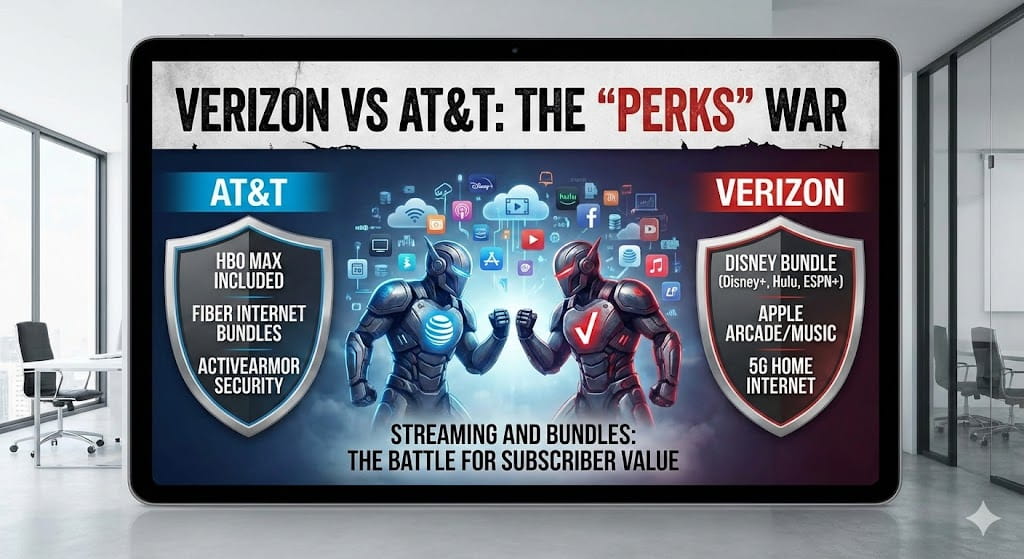
This is the biggest differentiator in the Verizon vs AT&T debate for 2026.
Verizon: The “myPlan” Ecosystem
Verizon completely changed the game by unbundling perks. Instead of forcing you into a plan with Disney+, they let you choose perks for $10/month each. Because these bundles are worth far more than $10, the savings are massive.
- Disney Bundle: (Disney+, Hulu, ESPN+) for $10.
- Netflix & Max: Both ad-supported versions for $10 (bundled together).
- Apple One: Apple Music, TV+, Arcade, and iCloud for $10.
- TravelPass: 3 days of international high-speed data for $10.
AT&T: Keeping it Simple (or Empty?)
AT&T has largely abandoned the streaming perks war. They no longer include HBO Max (now Max) for free.
- The Benefit: You aren’t paying for bloatware you don’t use.
- The Downside: You get zero entertainment value added to your bill. If you already pay for Netflix and Disney+, switching to Verizon could save you $15–$20 a month purely on subscription offsets.
Phone Deals and Upgrades:
Both carriers are aggressive with trade-in offers, often promising a “Free iPhone” or “Free Samsung Galaxy” if you trade in an old device and sign a 36-month contract.
- Verizon often restricts the best trade-in deals (up to $800-$1000 off) to their premium plans (Unlimited Plus/Ultimate). If you are on the cheap “Welcome” plan, your trade-in value plummets.
- AT&T historically offers the same trade-in deal to all customers, regardless of which unlimited plan they choose. This is a massive advantage for budget-conscious users who want a high-end phone but a cheaper monthly data plan.
Conclusion: Which Carrier Should You Pick?
The battle of Verizon vs AT&T doesn’t have a single winner it has a winner for you.
Choose Verizon if:
- You want to bundle streaming services (Disney, Netflix, Apple) and save money.
- You live in a rural area where reliability is king.
- You want the fastest possible 5G speeds in major cities.
Choose AT&T if:
- You want the flexibility to get the best trade-in deals on a cheaper plan.
- You are an existing AT&T Fiber customer (you can often get 20% off your wireless bill).
- You value consistent signal coverage over peak speed.
Ultimately, both networks are excellent. We recommend checking the specific coverage map for your zip code before switching, as local geography is always the final tie-breaker.
FAQ: About Verizon vs AT&T
Which carrier is actually cheaper, Verizon or AT&T?
For a single line, AT&T is often slightly cheaper on the sticker price. However, for families of 3-4 lines, Verizon’s “Unlimited Welcome” can actually be cheaper ($30/line vs AT&T’s ~$36/line). If you use streaming apps, Verizon becomes the better value due to the $10 perk bundles.
Who has better 5G, Verizon or AT&T?
Verizon has faster 5G (Ultra Wideband) in cities and stadiums. AT&T has broader 5G coverage that reaches more suburban and semi-rural areas, though often at slower speeds than Verizon‘s peak.
Does AT&T still give free HBO Max?
No. AT&T discontinued the free HBO (Max) benefit on their newer unlimited plans. Verizon now leads in streaming perks with their discounted bundles.
Can I keep my number if I switch carriers?
Yes. Federal law allows you to port your number from Verizon to AT&T (or vice versa) as long as your account is active and you have your transfer PIN.
Is T-Mobile better than Verizon or AT&T?
T-Mobile currently has the largest 5G network and faster average download speeds than both Verizon and AT&T. However, Verizon and AT&T still hold a lead in rural coverage reliability and indoor signal penetration in many parts of the country.
